

Sebahate J. Shala
Despite significant progress in prosecuting war crimes and establishing judicial truth through international and domestic courts, Bosnia and Herzegovina lacks a unified curriculum systematically addressing gross human rights violations committed during the war in 1992–1995. Education system remains fragmented along ethnic and administrative lines, resulting in competing or absent narratives about the past. The omission of the court-established facts from formal education limits public awareness, reinforcing denial, and undermining reconciliation. Consequently, the absence of history teaching on past atrocities constitutes a violation of international human rights laws, including the right to education, the right of the child to education, peace and non-discrimination, the right to the truth, and the guarantees of nonrepetition.
Theoretical and Legal Analysis: Education—Critical to Peace
Recognized under international human rights law, education is both a fundamental human right and a foundational pillar for advancing human rights, peacebuilding, and conflict prevention. The purpose of education system, as the Universal Declaration of Human Rights (1949) and the International Covenant on Economic, Social and Cultural Rights (1966) stipulate, should be to strengthen human rights and fundamental freedoms and promote understanding, tolerance, and friendship among all people, while contributing to the maintenance of peace. The Convention on the Rights of the Child (1989) guarantees “the right of the child to education” and “non-discrimination,” emphasizing that learning spaces should prepare children for a responsible life in a free society, grounded in understanding, peace, tolerance, equality, and friendship among all peoples. Given the importance of human rights–based education in societies in transition, transitional justice processes should address the full spectrum of economic, social, cultural, political, and civil rights to foster accountability and the rule of law (UNGA, 2012). The UN Basic Principles and Guidelines on the Right to Remedy and Reparation (2005) explicitly link education to transitional justice objectives, calling for the inclusion of accurate accounts of violent pasts “in educational material at all levels” and “for the provision of human rights and international humanitarian law education across society.” (Cole, 2017) Education also enables the realization of the right to the truth, which the Human Rights Council recognizes as essential to combating impunity and promoting human rights. Accordingly, the state has the duty to preserve, protect, and ensure access to archives and documentation of wartime abuses and to integrate this knowledge into schooling in support of accountability, rule of law, and the guarantees of nonrepetition (UNGA, 2012).
Beyond being a fundamental human right and a basic necessity, education is viewed as critically important to peacebuilding, conflict-prevention, and transitional justice (Nesterova et al., 2024), as well as an essential component to promote civic engagement and tolerance, while fostering international understanding and dialogue across diverse communities (Davies, 2017; UNESCO, 2025). Research indicates that proactive engagement with past injustices can play a transformative role (Ramirez-Barat and Duthie, 2015) and serve as a catalyst for conflict transformation and sustainable peacebuilding (Nesterova et al., 2024), as school spaces enable shape new norms, challenge contending narratives of the past, and promote respect for human rights and rule of law. Henceforth, critical and thoughtful teaching, as Nesterova et al. suggest, should be focused on two objectives: transforming people’s attitudes, values, and behaviors and transforming and building inter-group relationships (Id.). Correspondingly, a critical approach to history, as George put it, “contributes to truth-sharing, official acknowledgement of harms and suffering, recognition of survivors and preservation of their memories, and fosters restorative justice.” (2007) From a victim-centered perspective, the historical teaching lays the groundwork for reconciliation and collective healing as it “increases the visibility of victims and their descendants, recognizes their suffering, humanizes their experience, and highlights their agency and resilience.” (UNESCO, 2025) Conversely, selective omission or divergent history curricula threatens—not only collective forgetting and violence recurrence (Velez, 2021) but also reinforces the opposing history interpretations, enforcing the politics of denial, and impeding reconciliation and healing (Ramirez-Barat and Duthie, 2015). In other words, education, as shown in some cases, holds potential to both fueling conflict and increasing prospects for peace (Cole, 2017).
The conflict-sensitive history education has—until the past two decades—been an underdeveloped theme and a missing pillar from transitional justice programs despite acknowledged positive impacts of historical education to human rights and transitional justice areas (Cole, 2007; Davies, 2017; UNGA, 2012). The discussions have focused on proposals advocating that history education be aligned with transitional justice objectives or integrated into transitional justice approaches. Arguably the inclusion of explicit and implicit curriculum of the past legacies advances the overall transitional justice goals—including truth-telling, accountability, and the guarantees of nonrepetition—key for building just and peaceful societies based on the principles of human rights and rule of law (George, 2007; Velez, 2021). Transitional justice approaches to education, as Davies outlines, can shift education from being part of the problem to being part of the transition to a more peaceful society given the importance of truth-seeking or the acknowledgment of the truth to education system (2017). Furthermore, education is closely connected to truth-telling, complementing transitional justice mechanisms and helping prevent conflict recurrence. Studies examining the truth-seeking commissions in Columbia highlight the educator’s role in these processes, indicating that truth positively impacts both individual and societal levels. Truth-telling was considered a “necessity” and crucial for “making things right for humankind and for society,” particularly for victims and survivors, linking it directly to justice, change, and healing (Velez, 2021). That said, an integrated approach to education not only enables the society to engage in dialogue on the dealing with the past but also encourages education reforms from a human-rights and respect-for-the-democratic-rule-of-law perspective, recognizes the victims’ right to the truth and reparations, so the education itself, as Ramirez-Barat and Duthie suggest, can be, especially, one committed to guarantees of non-recurrence (2015). Lastly, truth-seeking can be crucial to conflict prevention and recurrence (Mendeloff, 2004) and increased societal trust (Fiedler and Mross, 2023) but only in combination with broader societal approaches such as victim restitution with amnesties or truth-finding and/or bridge-building activities.
The education system reforms in transition societies have shown mixed results, though, therefore, a context-specific approach to transitional justice is recommended in order to avoid potential harmful consequences. While initiatives to integrate schools in Northern Ireland have been partially successful, Rwanda and Bosnia and Herzegovina continue the segregation practices—same as Sri Lanka (Davies, 2017). The South Africa transformation process—known as “the most far reaching reform”—to date, on the other hand, has not helped break the post-apartheid socio-economic inequalities as intended to (Risana Ngobeni et al., 2023). The country embarked into a comprehensive education reform process, comprising—among others—measures including geographical restructuration of education departments, creation of a non-racial department, new national curriculum and textbook revisions, and the increase of funding and the redistribution of resources (Ramirez-Barat and Duthie, 2015). The inclusion of the truth-commissions and court proceedings in school curricula remains limited, too. The Truth and Reconciliation Commission in South Africa pioneered the model of using findings to reshape the national history curriculum, the Guatemala Commission for Historical Clarification provided recommendations for education purposes as did Sierra Leone. The latter introduced a creative model to truth-sharing in education sector, incorporating in its truth-seeking commission’s mandate the production of materials specifically intended to either school-based or non-school based education for youth (George, 2007).
Bosnia and Herzegovina: Education Reinforces Segregation and Ethnic Divisions
Bosnia and Herzegovina exemplifies a particularly complex post-conflict situation—where ethno-nationalist and political divisions continue to shape political and social life (Fischer, 2010; New York University, 2017). The deep and persistent organizational divisions—solidified through international peace agreements—have affected all aspects of political, economic and public domain, including the education system (Bobo Kovac, 2025). The Dayton Peace Accords (1995) and the Bosnian Constitution institutionalized ethnic fragmentations drawn by conflict, creating a complex political structure that reflects ethnic and national composition: Federation of Bosnia and Herzegovina with predominantly Bosnian and Bosnian Croats—and the Republika Srpska-Bosnian Serbs, including the autonomous Brčko District (Freeman, 2004). Whilst this political and legal framework set up the architecture of the new state, it failed to provide a comprehensive vision of transitional justice, resulting in ad hoc and incomplete transitional justice initiatives, particularly in truth-seeking and reparations measures (Id.). Henceforth, transitional justice mechanisms, including truth-seeking, reparations, memoralization, and institutional reform, have been partially applied, indicating entrenched political and ethnic divisions (Ramirez-Barat and Duthie, 2015; Teksen, 2019). Initiatives to adopt a national transitional justice strategy have been unsuccessful due to ongoing political and ethnic disagreements (Haris Rovcanin, BIRN, July 13, 2021). Instead, Bosnia and Herzegovina relies on the Revised National War Crimes Strategy focusing specifically on processing war crimes while disregarding restorative justice mechanisms (OSCE, 2020). The absence of an inclusive transitional justice approach has prevented the creation of a statewide truth and reconciliation commission—capable to establish facts on the Bosnian war—contributing to fueling revisionism, creating parallel or absent interpretations of war, exacerbating ethnic divisions, and undermining efforts for reconciliation and healing (UNGA, 2022). Consequently, the education reform was never anchored in transitional justice field. The human rights-based education—that would link the international and domestic court findings to learning materials—is neither aligned with nor integrated in the existing transitional justice programs.
The organization of education sector mirrors the state and administrative regulation defined by the constitution (Foric Plasto, 2020). Legally, the education system in Bosnia and Herzegovina is decentralized, providing the entity structures with the responsibilities over education matters, including the developing of core curriculum, and harmonization and adaptation of educational curricula (Law on Primary and Secondary Education, 2003). Presently, there are three main education systems at each level of authority; the Entities hold powers to determine the language of instruction and the content of the curriculum, involving the history teaching, with little or no control from the Federation (Forić Plasto, 2020; Wansink et al., 2025). In the absence of a state ministry of education to oversee and coordinate history teaching on state level, each department out of thirteen education departments across cantons, approves the use of textbooks and the curriculum. In some regions, meanwhile, guidelines on textbook use are provided by pedagogical institutes or educational inspectorates (Wansink et al., 2025). Although the Ministry of Civil Affairs covers, among others, the education matters, it is only responsible for the coordination and consolidation of entity policies and, where relevant, connecting them to international strategies or activities (ECRI, 2024). Hence, most of the history curricula remain strongly ethno-national in orientation, exacerbating divisions and tensions between ethnic and national communities (Wansink et al., 2025). Under the “two schools under one roof” phenomenon, oftentimes, students “from different ethnic groups attend the same school but are physically separated,” and they are taught in different languages and follow a specific ethnic curriculum (Ramirez-Barat and Duthie, 2015). Introduced as a temporary solution to reverse the post-war displacement and ethnic homogenization in some areas, the “two schools under one roof”—has unfortunately—become a permanent model—despite illegal and in violation of international and domestic human rights legislation (OSCE, 2018; UNGA, 2022). Efforts to create an integrated, inclusive education system and a more unified, state-level history teaching have largely failed (Wansink et al., 2025). The education policy reform, supporting the end of school segregation and discrimination, creating a unified, inclusive teaching, and incorporating multi-perspective history learning, have stalled due to political and ethnic disagreements (ECRI, 2024).
Fragmented and Selective History Education Hinders Healing and Reconciliation
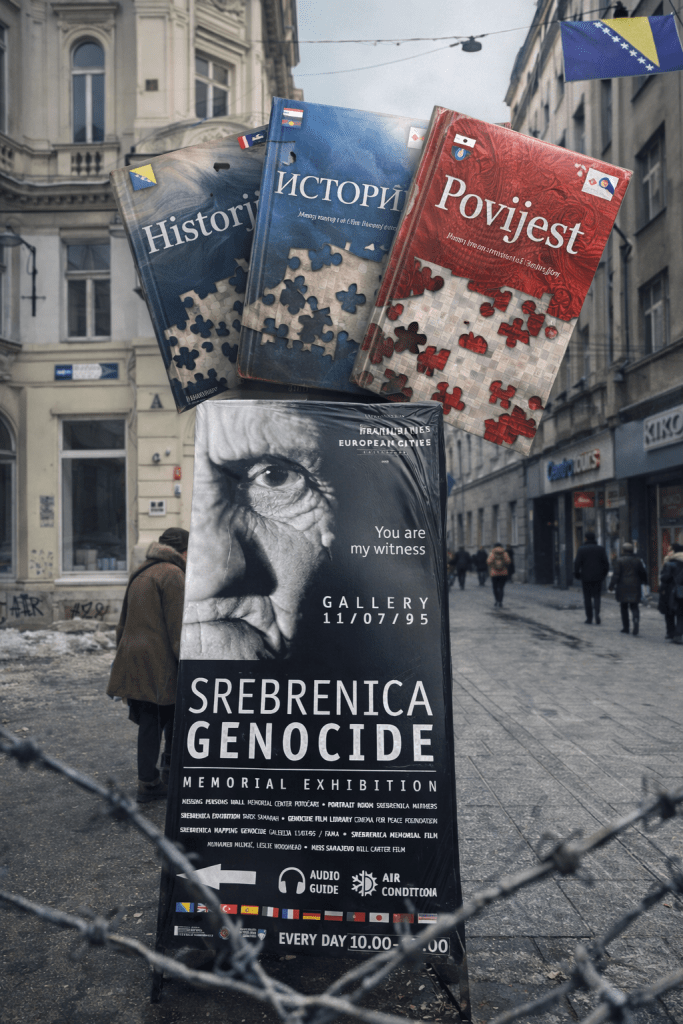
The fragmented education and divergent history textbooks and curricula have contributed to opposing or absent interpretations of large-scale human rights violations during the Bosnian war, reinforcing the politics of denial and the glorification of war criminals, while hampering efforts toward a unified truth (New York University, 2017; UNESCO, 2025). The glorification of war criminals and the denial of past atrocities has dominated the post-war Bosnian public discourse—a phenomenon that permeates politics, military institutions, education, and broader society—in spite of being criminalized by the International High Commissioner Representative (IHCR) in 2021 and condemned by the international community-based in Sarajevo (ICTJ, 2024; Sarah Moore, UCL, SLOVO, 2022). In addition, the absence of an inclusive approach to transitional justice, including an officially endorsed truth commission, has further fueled historical revisionism, perpetuating ethno-nationalist and wartime propaganda, particularly in the education system, which, in turn, have complicated truth-telling and accountability (UNGA, 2022). It is unanimously argued that existing history curriculum encourages ethnic divisions, segregation and discrimination, creates false and single historical accounts, fuels nationalism, and obstructs the development of a healthy, functional society (Bobo Kovač, 2025; Soldo et al., 2017). As some studies and media suggest, the history textbooks in three education systems offer a strong ethnically biased history interpretation—“us” versus “them”—all building a narrative of “celebrating us,” “devaluing them” and being victimized by two other groups (Bobo Kovač, 2025; BIRN, 2020). In an analysis examining the history textbooks of secondary education in two Bosnian Entities and in Serbia, BIRN found inaccurate and selective accounts relating to the 1990s Bosnian war. Each ethnic group approached war from their perspectives, omitting the established judicial facts while providing wrong classification of the major events, the total number of killings, and the personalities involved. Whereas the history textbook of Bosniak and Croat-dominated Federation hold the Bosnian Serb Army responsible for the Srebrenica massacres, the Republika Srpska textbook omitted the Srebrenica genocide, listing it among “mass crime locations,” while portraying Karadzic and Mladic as national heroes (Id.) The new textbook revisions in Republika Srpska presenting the convicted war criminals as heroes without addressing their criminal accountability established by The Hague Tribunal is outlawed by the Constitutional Court (Lejla Memcic, BIRN, January 24, 2025). The existing history textbooks not only violate the international and national human rights laws but also fail to affirm the universal principles of democratic society, active citizenship and social involvement, as well encourage critical thinking, creativity and active learning (Soldo et al. 2017) (ICTJ, 2024).
By reproducing ethnically exclusive narratives, education reinforces division and undermines the social conditions necessary for healing and reconciliation. The unilateral and selective approach to describing the Bosnian war increases mistrust among communities, hinders accountability for wartime atrocities, and threatens state stability, security, and economic prosperity (OSCE, 2018; ICTJ, 2024). Reconciliation in Bosnia and Herzegovina is a highly challenging and contested issue. Although there are numerous initiatives, focusing on peacebuilding, trust restoration, inter-ethnic dialogue, and youth engagement—such as the Marshall Legal Institute’s Inter-ethnic Reconciliation Program, the IOM’s Bosnia and Herzegovina Resilience Initiative (BHRI), and the Center for Peacebuilding (CIM) in Sanski Most, results remain limited due to political and social divisions. Reconciliation, as Gačanica points, requires time and profound changes in attitudes, as well as the establishment of a future-oriented framework that includes reforming how the past is processed and presented. The available literature identifies identity politics, structural and political system challenges, and the perpetuation of denial, particularly regarding the Srebrenica genocide, as key obstacles to reconciliation (Avtamovic, 2017). The education system and the absence of a shared educational engagement with past appears as a significant contributing factor (New York University, 2017). Given the education’s transformative role for future generations, lack of a shared history curriculum not only impedes reconciliation and healing (Ramirez-Barat and Duthie, 2015) but also risks collective forgetting (Velez, 2021). That said, school spaces hold the potential to influence both transitional justice and reconciliation by mediating tensions between justice and truth-telling processes and historical memory, on the one hand, and “learning to live together” and education for social cohesion, on the other (Ramirez-Barat and Duthie, 2015). Internally, divided education undermines critical reforms and effective history teaching, exacerbates ethnic divisions, and weakens healing and reconciliation, ultimately affecting the stability of Bosnia and Herzegovina itself; externally, it contributes to broader regional destabilization (Reynolds, 2017).
Lastly, the education system in Bosnia and Herzegovina has had a direct and lasting impact on the realization of international human rights and transitional justice obligations. Despite binding international and domestic laws—including the right to education, equality, non-discrimination, the right to truth, and the guarantees of nonrepetition—the ethnically divided education system has systematically undermined these commitments. This reality contradicts the objectives outlined in the-2002 education reform strategic documents and the domestic law on primary and secondary education, which commit, as stated by ministers of education, to ensuring equal access to quality education in integrated, multicultural schools—free from any interferences, and to upholding the rights of all children. Moreover, these shortcomings violate key international standards linking education to transitional justice, including the UNGA resolution on human rights–based education, the UN Basic Principles and Guidelines on the Right to a Remedy and Reparation (2005), the UNGA resolution on combating impunity and promoting human rights, and the Updated Set of Principles for the Protection and Promotion of Human Rights through Action to Combat Impunity (2005).
Recommendations: Comprehensive Approaches to History Education in Bosnia and Herzegovina
Instead of overhauling the entire system, a justice-sensitive (Davies, 2017), pluralistic approach to education (UNESCO, 2025) encompassing multiple perspectives, proactive engagement with the historical past, human rights and democratic citizenship-based learning, and textbook revisions must be considered. The designers of transitional justice programs should acknowledge that there is no single truth or perspective in post-conflict settings—a component insufficiently approached through international interventions (Fischer, 2010). A justice-sensitive approach, as Davies suggests, incorporates the change or removal of old—biased curriculum—with offensive material, creation of new historical records based on the victims and non-victors’ viewpoints, inclusion of human rights-and-democratic citizenship curriculum, and a critical approach to history teaching that led to human rights violations (Id.). From a transitional justice perspective, change is necessary to build a common understanding on past human rights violations and actions to upheld those rights in the future; from the education standpoint, change implies a deep understanding that both—the rights and the citizenship—must be promoted and protected by the law (Davies, 2017).
The UNESCO’s pluralistic approach to history education embodies the involvement of multiple perspectives, critical and thoughtful learning, and proactive engagement with the past legacies, enabling children to critically analyze historical research and shape contemporary discourse whilst confronting biased narratives and nationalist propaganda aimed at historical distortion and denial (2025). The overarching framework to education policy supporting critical and proactive engagement with violent pasts should be aligned with learning objectives, including as follows: strengthening historical literacy by establishing a clear historical understanding that is fact-and research-based, fostering multiple perspectives by including accounts of victim and perpetrator groups as well as affected populations, encouraging critical thinking by developing learners’ ability to resist disinformation, hate speech and distorted historical narratives, fostering human rights knowledge and awareness through learning on mass atrocities, and guaranteeing the right to the truth for victims and their families, and so forth (Id.).
Bosnia and Herzegovina is a difficult case that requires considerations of context-specifics to avoid harmful consequences. The education reforms should be based on ideology rather than on ethnicity and religion (Reynolds, 2017). The country should adopt policies in education, culture and the media—at all administrative levels—and provide comprehensive and accurate accounts on past violations based on established facts of international and national courts and narratives of victimhood, as well as educating people on history and culture of ethnic and national minorities and their contribution to society at large (UNGA, 2022). The education policy reforms must entail: ending national or ethnic segregation, implementing a common core curriculum, including on history and geography, ensuring minority students’ access to learning on their mother language and cultural heritage, adopting a multi-perspective approach to history teaching, and preventing the intrusion of divisive ethno-nationalist agendas in school curricula (Id.). An inclusive, pluralistic approach to history learning implies the use of textbooks that, according to historians, explain events from both sides—not denying the siege of Sarajevo, but not neglecting the suffering of all residents, including Serbs, in the besieged city; teaching methods should encourage critical thinking, dialogue, questioning, and openness toward alternative versions of history (Davies, 2017; Wansink et al., 2025). From a broader perspective, Bosnia and Herzegovina should endorse a comprehensive transitional justice strategy, including a national truth-seeking commission, and align education materials with transitional justice objectives.
BIRN Sarajevo. (2020, October 30). Bosnian, Serbian Schoolbooks Teach Rival Versions of History. By M. Obrenović.
BIRN Sarajevo. (2025, January 24). Bosnian Constitutional Court Bans History Lessons Glorifying War Criminals. By L. Memčić.
Cole, E. A. (2017). No Legacy for Transitional Justice Efforts Without Education: Education as an Outreach Partner for Transitional Justice. International Center for Transitional Justice.
Constitution of Bosnia and Herzegovina. (1995). Office of the High Representative, Department for Legal Affairs.
European Commission against Racism and Intolerance. (2024). ECRI report on Bosnia and Herzegovina. Council of Europe.
Fiedler, C., & Mross, K. (2023). Dealing with the Past for a Peaceful Future? Analyzing the Effect of Transitional Justice Instruments on Trust in Post-conflict Societies. International Journal of Transitional Justice, 17(2), 303–321. https://doi.org/10.1093/ijtj/ijad010.
Forić Plasto, M. (2020). A Divided Past for a Divided Future!? The 1992–1995 War in Current History Textbooks in Bosnia and Herzegovina. Journal of the Faculty of Philosophy in Sarajevo, 295–314. https://doi.org/10.46352/23036974.2020.2.295.
Framework Law on Primary and Secondary Education in Bosnia and Herzegovina, Official Gazette of BiH, No. 18/03 (2003).
Gačanica, L. (n.d.). Is Reconciliation a Priority for Bosnia and Herzegovina? Initiative for Monitoring the European Integration of Bosnia and Herzegovina. https://eu-monitoring.ba.
George, E. (2007). After Atrocity Examples from Africa: The Right to Education and the Role of Law in Restoration, Recovery, and Accountability. Boston University School of Law Working Paper Series.
Human Rights Council. (2012a). Resolution A/HRC/RES/21/7: Promotion and Protection of all Human Rights. United Nations General Assembly. (2012b). Resolution A/HRC/RES/21/15: Promotion and Protection of all Human Rights. United Nations General Assembly.
International Covenant on Economic, Social and Cultural Rights, Dec. 16, 1966, 993 U.N.T.S. 3.
International Organization for Migration. (n.d.). Bosnia and Herzegovina Resilience Initiative.
International Center for Transitional Justice, & UNICEF. (2015). Education and Transitional Justice: Opportunities and Challenges for Peacebuilding (C. Ramírez-Barat & R. Duthie, Eds.).
Kovač, V. B. (2024). “Us” vs. “Them”: A Systematic Analysis of History Textbooks in Post-war Bosnia and Herzegovina Across Three Ethnic Educational Programmes. Journal of Curriculum Studies, 56(3), 271–286. https://doi.org/10.1080/00220272.2024.2436353.
Marshall Legal Institute. (n.d.). Inter-ethnic reconciliation program.
Mendeloff, D. (2004). Truth-seeking, Truth-telling, and Post-conflict Peacebuilding: Curb the Enthusiasm? International Studies Review, 6(3), 355–380. https://doi.org/10.1111/j.1521-9488.2004.00421.x.
Moore, S. (2022, April 21). Bosnia’s Memory Problem: Competing Historical Narratives and the Threat to Peace. SLOVO Journal, University College London.
Ngobeni, R., et al. (2023). Curriculum Transformations in South Africa: Some Discomforting Truths on Interminable Poverty and Inequalities in Schools and Society. Frontiers in Education. https://doi.org/10.3389/feduc.2023.xxxxxx (add article DOI if available)
OSCE. (2018). “Two Schools Under One Roof”: The Most Visible Example of Discrimination in Education in Bosnia and Herzegovina.
Reynolds, A. (2017). Education Structure and Policy as Barriers to Transitional Justice in Bosnia and Herzegovina. Global Affairs Review, New York University.
Rethinking Bosnia and Herzegovina’s Past and Future: History Education Before the Constitutional Court. (2025, July 22). ICONnect. Soldo, A., et al. (2017).
Education in Bosnia and Herzegovina: What Do We (Not) Teach Children? Content Analysis of Textbooks of the National Group of Subjects in Primary Schools. Open Society Fund Bosnia and Herzegovina & proMENTE Social Research.
UN Economic and Social Council. (2005). Impunity: Updated set of principles to protect and promote human rights through action to combat impunity (E/CN.4/2005/102/Add.1).
UN General Assembly. (2005). Basic Principles and Guidelines on the Right to a Remedy and Reparation. Universal Declaration of Human Rights, G.A. Res. 217A (III), U.N. Doc. A/810 (1948).
Vélez, G. (2021). Teaching Truth in Transitional Justice: A Collaborative Approach to Supporting Colombian Educators. Harvard Educational Review, 23(1), 91–103.
 WAR AND PEACE
Leave a comment