
Assessing International System, Great-Power Competition, and Strategic Engagement in Europe, the Indo-Pacific, and the Western Hemisphere.
Sebahate J. Shala
The National Security Strategy outlines a recalibrated vision of the United States’ (U.S.) role in an evolving international system, prioritizing national interests and regional stability over expansive global commitments. It signals an unequivocal retreat from traditional U.S. global leadership role and as a defender of international rules-based order, advocating for regional balances of power and spheres of influence. Simultaneously, the document departs from the framework of great-power competition, advancing a more pragmatic approach toward managing major-power relations and safeguarding U.S. national interests. It further underscores the centrality of the nation-state over global governance, while offering, at times, inconsistent interpretations of the principles of national sovereignty and noninterference.
Reflecting this strategic reconfiguration, the doctrine emphasizes domestic resilience, economic strength, and the protection of the homeland as the core pillars of national power. It reorders global priorities and threats, shifting attention and resources from the Middle East and Europe toward Indo-Pacific and the Western Hemisphere framed as key geopolitical battlegrounds. Correspondingly, the document reshapes the discourse on allies and adversaries, adopting a more assertive tone toward Europe while avoiding explicit classification of Russia and China as direct threats to either the international system or U.S. national security. North Korea is notably absent from the text and Iran’s destabilizing force is comparatively downplayed in this iteration.
This article proceeds in five sections. It first examines how the National Security Strategy conceptualizes the international system and the U.S. position within it. It then analyzes the strategy’s treatment of great-power competition before turning to its regional priorities in Europe, the Indo-Pacific, and the Western Hemisphere.
International System: Reframing the Global Rules-Based Order
The National Security Strategy (NSS), unveiled in December 2025, represents a radical departure from U.S. national security frameworks since 2001, including its two immediate predecessors, by prioritizing an America First posture and emphasizing domestic and economic security as central to national power. The strategy signals a recalibration of American global leadership, moving away from traditional interventionism and the defense of the international rules-based order toward a more restrained, regionally focused, and transactional direction. This orientation is described as a “tacit abandonment of rules-based-foreign policy” and a “full-scale repudiation of America’s approach to the world” and liberal internationalism—once regarded as the cornerstone of global peace and prosperity, whilst international law, an integral part of the system, is entirely absent as there are reaffirmations of legal norms. Furthermore, the document underscores the primacy of national sovereignty and the nation-state over interdependence and transnational institutions, and selectively embraces a doctrine of noninterference in other nations’ affairs. In line with President Donald Trump’s political stance, the NSS is “more skeptical of alliances, less centered on values,” questioning the significance of traditional partnerships built around security alliances, trade integration, and democratic principles, endorsing instead the rebuilding of a broader allied network focused on military and economics. Moreover, the strategy reframes the allies’ roles and responsibilities, suggesting burden-sharing and burden-shifting as alternatives for permanent U.S. security arrangements, which requires allies and partners, particularly in Asia and Europe, to assume primary responsibility for their regional security and defense.
Building on this reassessment, the NSS deemphasizes democracy and universal human rights, highlighting economy as central dimension to international relations. The strategy makes no reference to human rights, democracy ranks far lower, whereas economy is defined as the foundation of America’s power and essential to guarantee its durable strategic advantages. The economic strength is presented as indispensable for achieving security and defense objectives, preserving the U.S. domestic security and global standing, and alongside trade, technology, and industrial capacity, is depicted as a strategic instrument of deterrence against large-scale military conflicts. The new NSS, as Atlantic Council puts it, is “as much an economic statecraft strategy as it is a national security strategy, justifying U.S. internationalism primarily based on economic interests, particularly in the Western Hemisphere, and […] reinforcing the importance of soft power.” Unlike the first Trump doctrine, articulating the U.S. role in promoting freedom and democracy worldwide, the Trump 2.0 adopts an interest-driven and selective ideological viewpoint, refraining from condemning rogue and authoritarian regimes, like China, and committing to cooperation with both democratic and non-democratic governments in Latin America, while at the same time criticizing Europe for democratic and cultural decline. This framing, according to experts, heralds the end of the era of nation-building and human rights conditionality, suggesting a greater acceptance for authoritarian partners in the Middle East that prioritize stability and energy over political and security reform.
Mayor Power Relations: Moving Beyond Great-Power Competition and Managing Security in Europe
The NSS marks a significant ideological and substantive shift in American foreign policy and the U.S. role in international system, reflecting a narrower conception of national interests—focused on domestic and economic security—as well as responding to evolving geopolitical realities. In contrast to its two immediate predecessors, the Trump 2.0 strategy signals an explicit retreat from the great-power competition that characterized post-Cold War system, rejecting the “ill-fated concept of global domination” in favor of global and regional balances of power, while simultaneously accepting spheres of influence. The White House, as expressively stated, renounces the pursuit of permanent American domination in the world system—a goal described as “fundamentally undesirable and impossible,” whereas instead of challenging, it operates within the existing geopolitical configuration. Accordingly, the administration redefines threats and challenges, reprioritizes global issues, and reframes the discourse regarding friends and adversaries. Irregular migration and transnational crime recast as major external threats, obscuring the traditional security threats such as nuclear proliferation, Russia and China’s dangers posed to international order, or global terrorism. Russia and China are no longer designated as “adversaries,” “fundamental threats to international system,” and seeking to shape a world “antithetical to U.S. values and interests.” North Korea, referenced sixteen times in the 2017-NSS, is entirely missing, whilst Iran is mentioned only briefly. The Middle East, an arena of geopolitical rivalries for over three decades, is not the primary area of focus, as attention shifts toward Indo-Pacific and the Western Hemisphere regions—described as the main geopolitical theatres. Although the strategy underestimates the “Iran problem,” asserting that its nuclear capability has significantly downgraded subsequent to Israel’s military operation in 2025, it recognizes the country as a “major regional destabilizer” and cautions to closely monitor its behavior as Washington pursues an investment-focused regional agenda. Yet, the NSS’s statement of intent on the Middle East conflicts the White House’s actions implemented since Trump returned to the office, including presentation and mediation of a peace deal on Israel and Palestine, intensive efforts to normalize Israel-Lebanon relations, and, most recently, the launch of military strikes against Iran.
Reflecting this strategic shift, the NSS modifies the rhetoric applied to friends and foes, adopting a more conciliatory tone toward Russia and China—whilst exhibiting an ideological hostility in relation to Europe. The Trump White House downplays the characterization of Russia as “aggressor” and “acute threat” to both international order and the U.S. national security, and constrains from referencing the conventional threat that Moscow poses to transatlantic security. Rather than a chief geostrategic adversary in European security landscape, Russia is defined more as a challenge that can be managed through stabilization measures and renewed diplomatic efforts. Unlike any strategy since 2001, including the first Trump doctrine, the new NSS does not center deterrence as the cornerstone of foreign policy vis-à-vis Russia, prioritizing stabilization, diplomatic engagement, and de-escalation over competition, confrontation, and deterrence. Equally, the administration displays a more tempered tone with respect to China, avoiding its designation as a “systemic and institutional challenge,” omitting the mention of its authoritarianism, while describing “China threat” almost entirely in economic lens. This, as experts indicate, marks the first time since 1988 that a U.S. National Security Strategy neither condemns Beijing’s governance system nor expresses an intent to promote its democratic reform. Instead, Washington positions China as the premier, long-term, economic competitor—a rhetorical formulation, suggesting a move from overt ideological labeling to a more transactional and economically centered viewpoint. Conversely, the NSS adopts an ideological, revisionist, and interest-driven approach to Europe, marking a decisive shift in future transatlantic relations. The new strategy criticizes Europe for “civilization erasure” and for losing its Western identity mainly due to domestic anti-democratic policies, namely migration, and the supranational character of the European Union—both perceived as the biggest threats confronting America in Europe.
In line with Trump’s viewpoint, the NSS endorses a reduced American engagement in Europe, prioritizing burden-sharing and an accelerated self-reliance alongside stabilization of relations with Russia and restoration of safety and stability in Europe. The strategy urges transatlantic allies to assume primary responsibility for their security and defense, enabling Washington to redirect its focus and resources to other geopolitical regions. Accordingly, Europe must commit to increase investment in defense capability and deterrence system, accelerate modernization and rearmament, reinvigorate industrial capacity, strengthen regional cooperation, and meet NATO defense spending threshold. Besides, the NSS supports an expedited settlement on Ukraine conflict—with U.S. as the main arbiter—in order to reestablish conditions of stability within Europe and strategic stability with Russia, while also preventing escalation or expansion of conflict across the region. Notwithstanding, the document reveals several notable omissions in relation to Russia, Ukraine, and Europe. First, the strategy entirely underplays Russian aggression in Ukraine, reducing it to “waging a war”; second, it characterizes the conflict as merely a “hostility”; and third, it references Russia only in context with Europe, elevating it as “managing European relations with Russia,” while noting that Europe sees Moscow as an “existential threat” but avoids any discussions of the threat that Russia poses to U.S., Europe, and the wider world. Experts view the articulation of conflict cessation in Ukraine—without the provision of future guarantees to security arrangements—as insufficient and with profound implications for Europe. As Cattler puts it, “The NSS frames Ukraine primarily as a conflict to be closed—not as a security architecture to be built. The absence of a reinforced long-term U.S. defense commitment leaves Europe with an expanded responsibility to define Ukraine’s strategic future.” This discourse, as others argue, is particularly problematic given Russia’s refusal to engage with U.S. in efforts to ending the war in Ukraine, yet, they continue, it is good enough to support a good-enough policy if Trump decides to push Russia to achieve this core interest.
Nonetheless, in spite of its criticisms, the NSS recognizes Europe’s enduring strategic importance and comparative advantages, including its nuclear capabilities vis-à-vis Russia, describing the continent as “strategically and culturally vital to the United States,” while positioning trade as central to both the global economy and American prosperity. Importantly, the strategy does not advocate withdrawal; rather, it expressively cautions that “not only can we not afford to write Europe off—doing so would be self-defeating for what this strategy aims to achieve.” Instead, it calls for reprioritization of finite resources and political capital toward other geopolitical arenas.
Indo-Pacific: Sustaining Regional Balance and Strategic Partnerships While Countering China’s Growing Influence
Indo-Pacific represents one of the global issues about which President Trump remains consistent with the 2017-NSS, defining the region as essential non-hemispheric theater for geopolitical competition—with China elevated as the principal economic rival. The strategy marks the end of the long-term China systemic challenge posed to the U.S. national interests, positioning economics as “ultimate stakes”—while relegating geopolitics to a supporting role. Additionally, the NSS reiterates the American commitment to maintaining a free and open Indo-Pacific and holds that the region will continue to be among the next century’s “key economic and geopolitical battlegrounds,” and asserting that “to thrive at home, we must successfully compete there—and we are.” Consequently, the document endorses the building of regional alliances and strengthening partnerships, surprisingly highlighting cooperation with India and the Quad as crucial to both—outmaneuvering China’s growing influence and for ensuring long-term security and stability in the region. Most importantly, Washington takes greater stock on Taiwan—though not on its political status but its strategic position—prioritizing “deterring a conflict” and rejecting “any unilateral change to the status quo in the Taiwan Strait,” suggesting a move on U.S. declaratory policy regarding Taiwan independence from non-support to opposition.
The NSS approach to Indo-Pacific combines policies and measures that seek to sustain U.S. economic independence and regional advantages parallel to preventing a military conflict through economic strength. The White House’s overarching policy involves objectives as follows: rebalancing U.S.-China unfair economic relationship toward a more advantageous one and through a “robust and ongoing focus on deterrence” to prevent a war in Indo-Pacific; a disciplined economic action to avert conflict over Taiwan; upholding freedom of navigation in the South China Sea; reinforcing regional cooperation; and endorsing the Quad (Australia, India, Japan, United States). The strategy advances further the notion of alliances centered on economic and military cooperation, explicitly calling for burden-shifting not just burden-sharing to counterbalancing China’s power and consolidating American regional preeminence. “In doing so, we should aim to restore a military balance favorable to the United States and to our allies in the region” additionally to robust commercial diplomacy targeting countries with greater prospects for major global economic growth. The rebalance of global trade relationships,which America First diplomacy aims to achieve, requires a greater role of European and Pacific allies as well as Canada and Mexico toward adoption of trade policies and implementation of burden-sharing and cost-shiftingstrategies, including substantially increasing defense spending and strengthening military capabilities, so to constrain China’s global expansion. Within this framework, Washington marks a significant departure in reintroducing the-Biden Quad and highlighting strategic alliance with India as essential to managing future U.S.-China competition and guaranteeing safety and stability in the region. Nevertheless, analysts cast skepticism about the NSS’s focus on India—which is interpreted more as an instrumental strategy rather than a signal of transition to a deepening partnership, mainly reflecting the U.S. broader foreign policy to Russia and China, while also responding to latest political developments such as President Vladimir Putin’s visit to India and the anticipation of multiple bilateral agreements. In sum, the NSS course of action on Indo-Pacific reveals a readjustment rather than a strategic shift, with a continued competition with China, particularly on economics (and extended to military, technology, and intelligence), a rivalry that remains centric despite the omission of strategic competitor framing, thereby shifting away from overt ideological labeling to a more transactional and economically centered approach.
Western Hemisphere: Mitigating Regional Threats and Securing Strategic Assets
While Indo-Pacific remains central to great-power competition, the NSS simultaneously redirects attention closer to home, elevating Western Hemisphere as a critical arena for securing U.S. strategic interests. The Trump Corollary to the Monroe Doctrine seeks the restoration of America’s economic and military supremacy after decades of its over-commitment in the Middle East, Asia, and Europe and resulting of failed strategies to impose difficult choices about priorities and resource allocation in the region. The new doctrine recasts irregular migration, transnational crime, and foreign incursion as primary security threats, reconsidering the relocation of the military, and if necessary, the use of unilateral action, as the subsequent National Defense Strategy (NDS) asserts, to safeguarding U.S. economic and national interests. Interpreted by some as an attempt to reassert neo-imperialist influence, the NSS, others argue, follows a logical focus on strategic geography, building on Trump’s first framework and responds to the changing geopolitical landscape. Strategically, the Trump Corollary is important not only for emphasizing the hemisphere’s geographic proximity to the homeland but also for its security and economic implications for American interests. First, the Corollary is critical for protecting Americans from immediate threats stemming from regional instability and foreign influence; second, it supports the advancement of U.S. national interests closer to home. As Atlantic Council puts it, “This NSS is remarkably and refreshingly frank about the essential objectives of the United States: securing the homeland, which requires a secure Western Hemisphere, and preventing outside great power adversaries from exerting malign influence in the hemisphere.”
First and foremost, the NSS highlights unlawful migration, illicit drugs, and narcotics cartels as the most immediate external threats to U.S. national security and key sources of regional instability, adopting a primarily security-centric approach to countering organized crime rather than relying on conventional law-enforcement measures. The strategy refers to the loss of American lives resulting from the intertwined threats of illegal migration and transnational crime. The available data support these claims. Latin America and the Caribbean countries account for the largest share of unauthorized immigrants in the United States—with the southern border remaining the primary locus of illegal crossings and encounters and as one of the world’s deadliest migration routes. The latest estimates indicate that more than 5,400 people have died or gone missing on U.S.-Mexico border between 2014 and 2024, totaling to approximately 10,000 deaths or disappearances since the enforcement of Prevention Through Deterrence in 1994, with number of deaths up to 80,000, based on local human rights groups’ data. Even though the threat is often overstated, persistent large-scale irregular migration at the southern border is increasingly portrayed as intersecting with transnational criminal activity—both dynamics elevated as challenges to U.S. national security. Against this backdrop, President Trump issued an executive order designating Transnational Criminal Organizations (TCOs), namely the Mexican cartels, as Foreign Terrorist Organizations (FTOs), marking a significant shift toward rearticulating drug cartels and illicit networks as central national security threats. In a confidential notice to Congress, as news organizations reported, the administration further asserted that the U.S. is engaged in a formal “armed conflict” with drug cartels characterized as “unlawful combatants,” a designation used to justify the military strikes in the Caribbean sea on the grounds of self-defense against threats to national security interests. Most consequentially, drug cartels, as the Drug Enforcement Administration suggests, remain the dominant group for producing and trafficking illicit synthetic opioids—chiefly fentanyl and methamphetamine—rendering drug poisoning the leading cause of death among working Americans, superseding deaths from traffic accidents and/or other diseases. In 2024, the National Center for Health Statistics recorded 79,384 deaths from drug overdoses, including synthetic opioids, underscoring the dire threat of Mexican cartels and their networks to U.S. public health, the rule of law, and national security, and for the safety and stability of the Western Hemisphere.
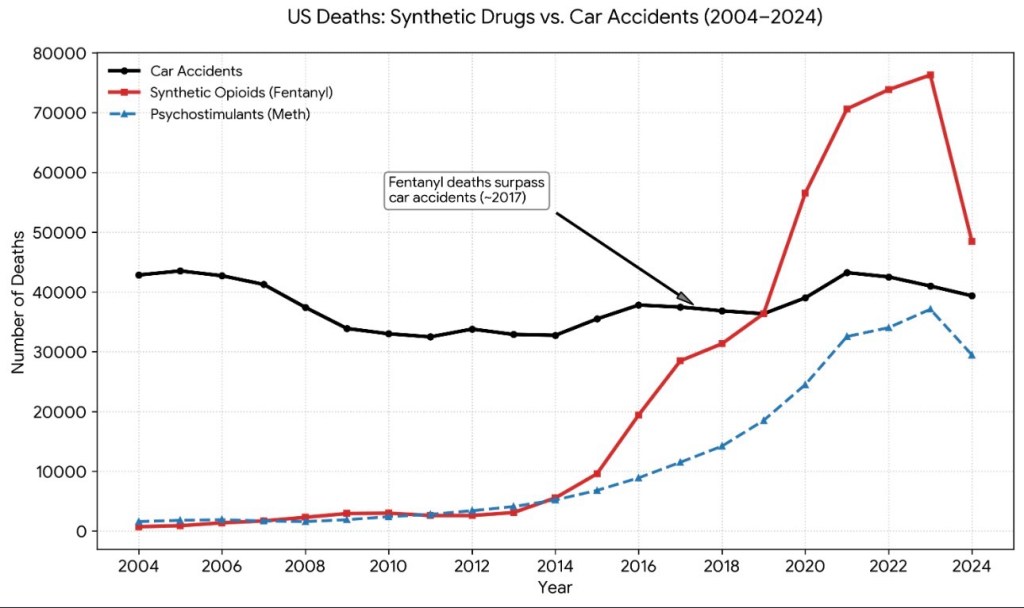
Figure 1. Line Chart Comparing U.S. Deaths From Synthetic Opioids (Fentanyl), Psychostimulants (Methamphetamine), And Car Accidents From 2004 to 2024. CDC National Center for Health Statistics (NCHS) and NHTSA Traffic Safety Facts. 2024.
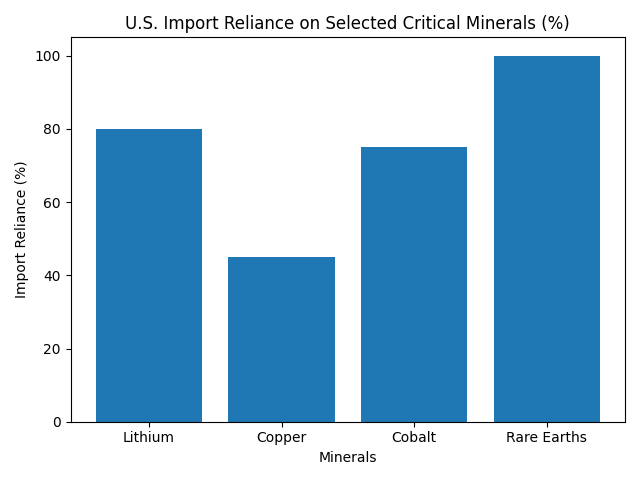
Second, the NSS advances a broader strategic vision for Western Hemisphere, positioning it as a critical area for securing key strategic locations and vital supply chains—from Arctic to South America—and directly linking the area to U.S. national and economic security. Correspondingly, the strategy seeks to counter the expanding influence of foreign adversaries, particularly China and Russia, emphasizing the need of preserving the U.S. geopolitical leverage in the region. In accordance with Trump’s statements, the Corollary highlights Greenland, the Panama Canal, and the Gulf of Mexico, as key strategic and economic assets, warning that their potential control by China would constitute a direct threat to U.S. national interests. The Panama Canal remains a vital artery of global trade and a cornerstone of U.S. economic and military security, enabling commercial flows and rapid naval mobility between the Atlantic and Pacific Oceans. Greenland, meanwhile, is strategically significant due to its Arctic location and vast mineral resources. Beyond consolidating control over such assets, the NSS also calls for guaranteeing the U.S. access to critical minerals (lithium, copper, and rare earths) and energy resources (oil, gas, and coal), alongside promoting “nearshoring,” reindustrialization, and infrastructure investment. This concern is underscored by the U.S. continued reliance on external sources—particularly China—for critical minerals. Over the past three decades, Beijing has utilized regional partnerships to secure supply chains, controlling an estimated 40 to 90 percent of global processing capacity for key minerals such as lithium, cobalt, and copper despite producing only a fraction of them. As of 2024, the United States relied on imports to meet approximately 45 percent of its copper demand and remains fully import-dependent for 12 of 50 designated critical minerals, with significant reliance on many others. Latin America is central to this equation: it produces a substantial share of global copper, holds the world’s largest lithium reserves, and represents a region where economic and security dynamics directly affect U.S. national interests.
To achieve the stated objectives over the Hemisphere, the NSS adopts a less ideological stance compared to Europe, committing to cooperate with both democratic and non-democratic governments through enlisting and expanding partnerships and by leveraging commercial diplomacy as key instrument in such endeavors. Consequently, President Trump issued earlier this year an executive order, calling for enhanced international cooperation, particularly with hemispheric countries, on critical minerals security. In parallel, the administration launched the Project Vault initiative aimed at establishing a strategic reserve of critical minerals and securing resilient supply chains, including facilitating financing for resource-rich Latin American countries such as Chile, Argentina, and Brazil. Critical minerals underpin both the digital economy and modern military capabilities, supporting technologies ranging from electronics to advanced weapons systems to clean energy infrastructure.
Taken together, the National Security Strategy reflects a decisive shift toward a more selective, interest-driven U.S. engagement with the world, prioritizing regional stability and economic strength over global leadership ambitions. Whether this recalibrated posture enhances long-term strategic influence or accelerates the erosion of the U.S.-led international order remains an open and consequential question. The strategy concludes its presentation with a forward-looking note in support of America’s greatness: “The goal of this strategy is to tie together all of these world-leading assets, and others, to strengthen American power and preeminence and make our country even greater than it ever has been.”
Primary Sources
The White House. (2017). National Security Strategy of the United States of America.
The White House. (2022). National Security Strategy.
The White House. (2025). National Security Strategy.
The White House. (2025, January 20). Designating Cartels And Other Organizations as Foreign Terrorist Organizations And Specially Designated Global Terrorists.
Reports and Data
U.S. Department of Defense. (2026). National Defense Strategy.
U.S. Department of Justice, Drug Enforcement Administration. (2025). National Drug Threat Assessment 2025. (2025, May).
Garnett, M. F., & Miniño, A. M. (2026, January). Drug Overdose Deaths in the United States, 2023–2024. National Center for Health Statistics, Centers For Disease Control And Prevention. (NCHS Data Brief No. 549).
Human Rights Watch. (2024, June 26). U.S.: Border Deterrence Leads to Deaths, Disappearances.
International Organization for Migration. (2023, September 2). U.S.-Mexico Border World’s Deadliest Migration Land Route.
Passel, J. S., & Krogstad, J. M. (2025, August 21). U.S. Unauthorized Immigrant Population Reached A Record 14 Million In 2023. Pew Research
Analysis and Commentary
Anderson, J., et al. (2025, December 4). Breaking Down Trump’s 2025 National Security Strategy. Brookings Institution.
Atlantic Council. (2025, December 5). What Trump’s National Security Strategy Means For U.S. Foreign Policy.
Baskaran, G. (2026, January 15). New Executive Order Ties U.S. Critical Minerals Security to Global Partnerships. Center for Strategic and International Studies.
Cattler, D. (2025, December 8). What the New U.S. National Security Strategy Really Signals For Europe. International Centre for Defense And Security.
Ernst, M. A. (2026, December 11). The “Trump Corollary” in the U.S. Security Strategy Brings a New Focus on Latin America—But it is a Disordered Plan. Chatham House.
Gray, A. (2025, July 1). The Trump Administration’s Foreign Policy Goals: A Hemispheric Defense of U.S. Interests. Ronald Reagan Institute.
Harding, E. (2025, December 5). The National Security Strategy: The Good, the Not So Great, And the Alarm Bells. Center for Strategic and International Studies.
Hernandez, A. C. (2026, February 9). Rethinking the 2025 White House National Security Strategy. Trends Research & Advisory.
Howell, S. (2023, May 5). Latin And South America Are a Key to the United States’ Critical Minerals Puzzle. The Diplomat.
HUNTON. (2026, February 6). The U.S. National Defense Strategy and Latin America’s Mining Industry: Strategic Minerals And the Role of DFIs.
Jeyaretnam, M. (2025, October 3). Trump Tells Congress U.S. is at War With Cartels: What That Means. TIME.
Kerwin, D., and Martínez, D. E. (2024, October 15). Forced Migration, Deterrence, And Solutions to the Non-Natural Disaster of Migrant Deaths Along the US-Mexico Border And Beyond. Center for Migration Studies.
Lissner, R., et al. (2025, December 6). Unpacking a Trump Twist on the National Security Strategy. Council on Foreign Relations.
Mitchell, W. A. (2026, January 14). The Grand Strategy Behind Trump’s Foreign Policy. Foreign Policy.
Preble, C., et al. (2025, December 9). Experts React: Trump Administration’s National Security Strategy. Stimson Center.
Ray, C. A. (2025, December 10). The New U.S. National Security Strategy: A Transactional Document That Marginalizes Allies. Foreign Policy Research Institute.
Sun, C. (2026, January 12). How China Reads The 2025 U.S. National Security Strategy. Brookings Institution.
Winton, S. (2025, July 11). America Must Secure Its Influence in The Western Hemisphere. The National Interest.
 WAR AND PEACE
Leave a comment